
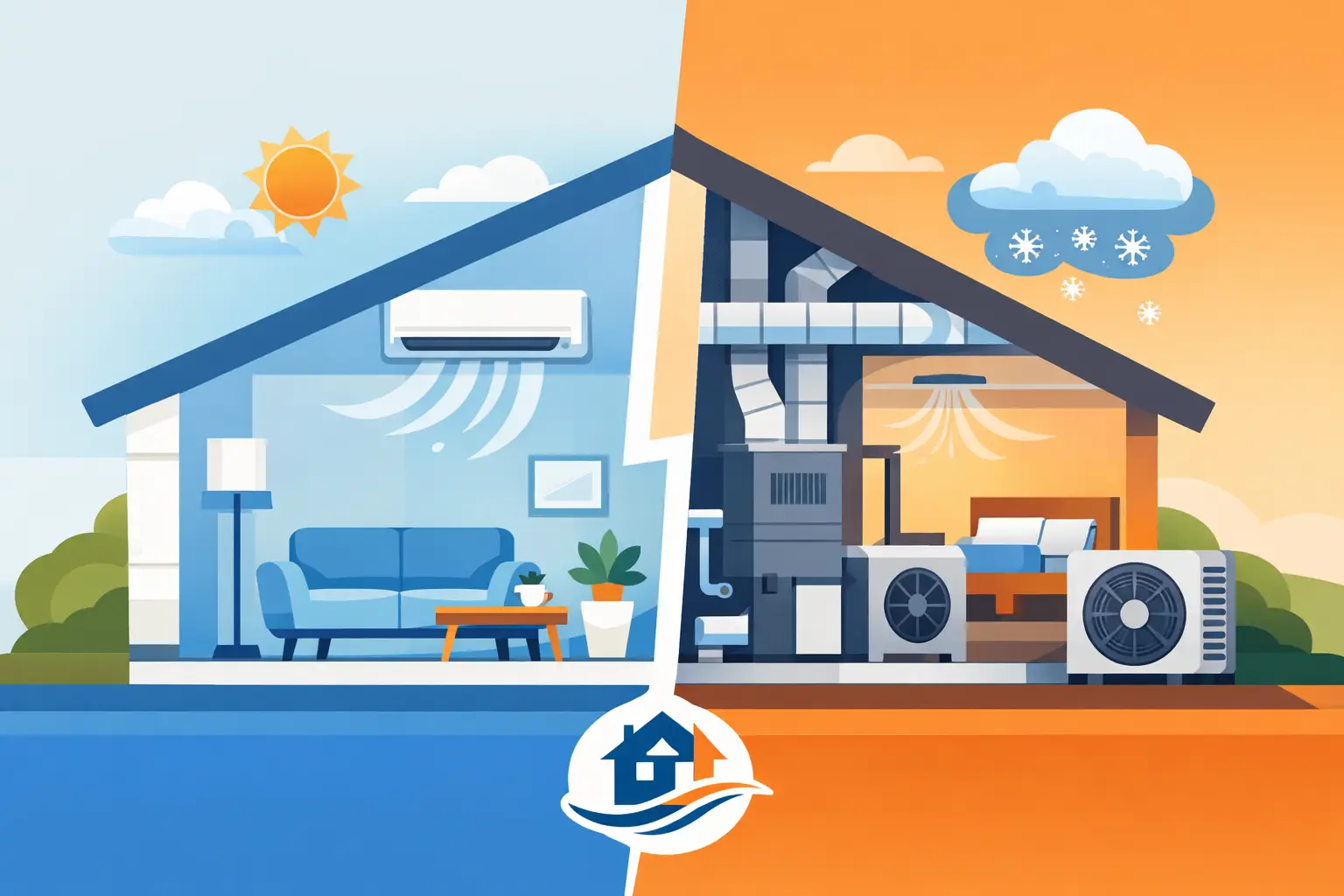
A top-floor bedroom that never cools down, a finished basement that stays damp, and utility bills that climb every summer are not problems a thermostat setting can solve. When homeowners compare ductless versus central air, the right answer depends less on what is newest and more on how the property is built, used, and heated. Both options can provide efficient, dependable comfort. The best choice is the one that solves your specific comfort problems without creating unnecessary cost or disruption.
Ductless Versus Central Air: The Key Difference
Central air conditioning uses one outdoor condenser connected to an indoor coil and a network of ducts. Cool air travels through supply vents, while return ducts bring indoor air back to the system. It is designed to condition much or all of a home from a central location.
A ductless mini-split system also has an outdoor unit, but it delivers heating and cooling directly to individual indoor air handlers. Those wall-mounted, ceiling-mounted, or concealed units connect to the outdoor equipment through small refrigerant lines. No large ductwork is required.
That difference affects nearly every part of the decision: installation scope, room-by-room control, air distribution, upfront investment, maintenance, and the way the system performs in an older New York home or a commercial space with changing needs.
When Central Air Is the Better Fit
Central air often makes the most sense for homes that already have properly designed ductwork in good condition. If your house uses a forced-air furnace and its ducts reach every occupied room, adding or replacing central air can be a practical, clean solution. One thermostat can manage the whole home, and the equipment stays mostly out of sight.
For many families, central air delivers the familiar whole-home experience they want. Every bedroom, hallway, living room, and kitchen receives conditioned air through the same system. With the right sizing and airflow design, it can maintain even temperatures throughout the home while also filtering the air as it circulates.
Central systems can also be a strong option when you are already planning major renovations. Opening walls and ceilings for construction can make it easier to repair, resize, or install ductwork. This is especially relevant in larger homes where multiple ductless indoor units may not match the appearance or layout preferences of the owner.
Still, existing ducts are not automatically a reason to choose central air. Leaky, undersized, poorly insulated, or badly routed ductwork can waste energy and leave distant rooms uncomfortable. Before recommending a replacement system, a qualified technician should inspect the condition of the ducts, not just the age of the air conditioner.
Central Air Benefits at a Glance
Central air is often the practical choice when you want whole-home conditioning from a single system, prefer discreet vents over visible indoor units, and have ducts that are properly sized and sealed. It may also make sense when an existing furnace, air handler, and duct system can be used effectively.
The trade-off is that central air conditions broad areas together. A sunny upstairs bedroom and a lightly used guest room may receive the same cooling schedule even though they need very different amounts of comfort.
When Ductless Mini-Splits Make More Sense
Ductless systems are especially useful where ducts do not exist or where existing ducts cannot serve a space well. Think of a brownstone addition, attic conversion, garage office, enclosed porch, basement suite, or a single bedroom that runs hot every July. Instead of extending ductwork through finished spaces, a ductless unit can deliver conditioned air directly where it is needed.
This approach is common in older homes throughout New York City, Westchester, Long Island, and Southern Connecticut. Many properties were built with boilers and radiators, not forced-air systems. Installing full ductwork later can require significant construction, reduce ceiling height, or affect architectural details. Ductless equipment can offer cooling and, with a heat pump, efficient heating without that level of disruption.
The biggest advantage is zoning. Each indoor unit has its own temperature control, so occupied rooms can be comfortable without conditioning every unused space. A home office can stay cool during the day, while bedrooms can be set differently overnight. For households with different comfort preferences, that flexibility is more than a convenience.
Modern inverter-driven mini-splits also adjust output as room conditions change. Rather than simply turning fully on and off, they can operate at lower levels to maintain a steadier temperature. This can improve comfort, reduce noise, and limit energy use when the system is properly selected and installed.
Ductless is not automatically the least expensive option. A single-zone system for one room can be very cost-effective. Outfitting a large home with several zones, electrical upgrades, and multiple indoor heads may cost as much as or more than a central system. The right comparison should consider the complete project, not only the price of one outdoor unit.
Efficiency Depends on the Entire Installation
It is easy to compare equipment ratings and assume the highest number wins. SEER2 ratings matter for cooling efficiency, and heat-pump ratings matter for heating performance, but ratings alone do not guarantee lower operating costs.
With central air, duct leakage and poor airflow can undermine even high-efficiency equipment. Conditioned air that escapes into an attic, crawlspace, or wall cavity never reaches the rooms you are paying to cool. Dirty filters, restricted returns, and incorrect refrigerant charge can create similar problems.
With ductless equipment, the details are different but just as important. Indoor units need the correct capacity and location for the room. A unit that is oversized may cool quickly without adequately removing humidity. A unit that is too small may run constantly and struggle during extreme weather. Refrigerant lines, condensate drainage, electrical work, and outdoor-unit placement all need professional attention.
For either system, accurate load calculations are essential. Square footage is only one part of the picture. Window exposure, insulation, ceiling height, occupancy, appliances, air leakage, and the local climate all affect the capacity your home or business needs.
Comfort, Humidity, and Indoor Air Quality
Air conditioning should do more than make a room feel colder. In the Northeast, humidity control is a major part of comfort. When a system is correctly sized and runs long enough, it removes moisture from the air. This helps rooms feel less sticky and can reduce the conditions that contribute to musty odors.
Central air provides one built-in advantage for homes focused on whole-house filtration. Air passes through a central filter each time it circulates, and some systems can support upgraded filtration or indoor air quality accessories. That can be valuable for households concerned about dust, pet dander, and seasonal allergens.
Ductless systems have washable filters inside each air handler, but they require regular cleaning. Because each unit serves its own zone, maintenance cannot be ignored in rarely used rooms. If filters or coils become dirty, airflow, efficiency, and air quality can suffer.
Neither system eliminates the need to address underlying moisture, ventilation, or air-quality concerns. A damp basement may need drainage or dehumidification. Persistent respiratory symptoms may call for a closer look at filtration, ventilation, and potential contaminants. Comfort equipment works best as part of a complete indoor environment plan.
Installation and Appearance Matter
A central installation can be straightforward when usable ducts are already in place. When they are not, it may become a construction project involving soffits, closets, ceilings, and wall cavities. That work can be worthwhile for a long-term whole-home solution, but it should be planned honestly from the beginning.
Ductless installation is usually less invasive. Small openings connect the indoor and outdoor components, and many projects can be completed without opening large sections of finished walls. Indoor heads are visible, though, and placement should be discussed before work begins. They should be positioned for effective airflow, practical service access, and an appearance that fits the room.
For some properties, a hybrid approach is the best answer. Central air can handle the main living areas while a ductless unit addresses an addition, a top-floor bedroom, or a room that never receives enough airflow. There is no rule that says one system must do everything.
Ask These Questions Before Choosing
Before approving an installation, ask whether your existing ducts have been inspected, whether the contractor performed a load calculation, and how each proposed system will handle the rooms that are currently uncomfortable. You should also understand what is included in the estimate: electrical work, permits where required, thermostat controls, condensate drainage, equipment warranty, and cleanup.
For heat-pump options, ask how the system will perform during winter weather and whether it will work alongside your current heating equipment. A properly designed heat-pump system can provide efficient year-round comfort, but the design should reflect your building and heating goals.
A trustworthy recommendation should not begin with the most expensive equipment. It should begin with how you use the space, what is failing today, and what will provide reliable comfort for years ahead. Rite Temp HVAC LLC helps homeowners and property managers evaluate those details with clear options and professional guidance.
Your comfort should not depend on closing off rooms, dragging out window units, or accepting a system that cannot keep up. A careful in-home assessment can turn the ductless versus central decision into a practical plan for quieter operation, better temperature control, and comfort your family can count on in every season.