A hot New York afternoon is a bad time to learn that your air conditioner can no longer keep up. If you are asking when should AC be replaced, the answer is rarely based on one issue alone. Age, repair history, rising utility costs, uneven cooling, and the type of refrigerant in the system all matter. A professional evaluation can separate a repairable problem from a system that is costing you more than it is worth.
Replacing an AC is a meaningful investment, so it should never be a high-pressure decision. The right choice is the one that protects your comfort, budget, and property for the years ahead.
When Should AC Be Replaced Instead of Repaired?
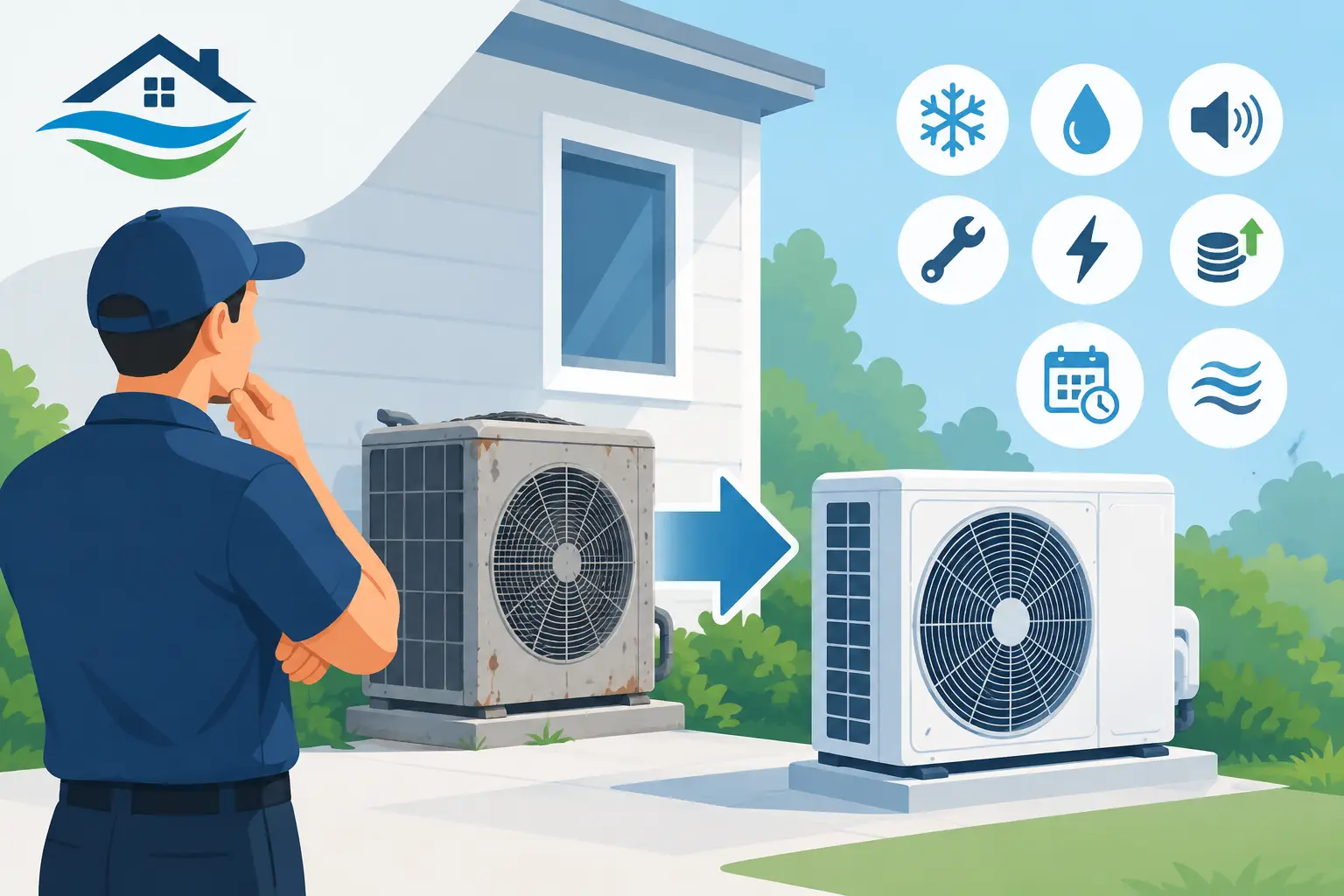
Most central air conditioners last about 12 to 15 years with regular professional maintenance. Some well-maintained systems can operate longer, while units exposed to heavy use, coastal conditions, poor drainage, or neglected service may wear out sooner. Age alone does not automatically mean replacement, but it changes the value of another major repair.
For a newer unit with a straightforward issue, such as a failed capacitor, contactor, thermostat, or clogged drain line, repair is usually the practical option. These are common parts that can often be corrected without replacing the equipment.
The calculation changes when an older system needs an expensive compressor, evaporator coil, condenser coil, or refrigerant-related repair. A useful rule of thumb is to multiply the repair cost by the unit’s age. If that number is close to or greater than the cost of a replacement system, it is time to seriously compare both options. For example, a $1,200 repair on a 14-year-old AC produces a figure of $16,800. That does not make replacement automatic, but it signals that putting more money into the old unit may not provide long-term value.
A qualified technician should explain the repair, its expected life, and the condition of the rest of the system. Honest guidance includes both paths, not just a replacement quote.
8 Signs Your Air Conditioner May Be Near the End
1. Your AC is 12 to 15 years old
An older system can still run, but its efficiency and reliability may decline after a decade or more of summers. If your unit is approaching this range and needs recurring repairs, planning replacement before a complete breakdown gives you more time to choose the right equipment.
2. Repairs are becoming frequent or expensive
One service call does not mean your air conditioner is finished. But repairs that happen every season, especially for different components, often point to broad system wear. Paying for repeated temporary fixes can become more expensive than installing dependable equipment with a manufacturer warranty.
3. Cooling is uneven from room to room
A bedroom that stays warm while the living room feels cold may be caused by duct leaks, poor insulation, airflow restrictions, or incorrect system sizing. It can also indicate an aging AC that is losing capacity. Before replacing equipment, have the entire system evaluated. A larger unit is not always the answer, and an oversized system can create humidity problems and short cycling.
4. Utility bills keep climbing
Summer electric bills naturally rise when temperatures do. What deserves attention is a steady increase without a clear change in how you use the home or business. As coils become dirty, motors weaken, refrigerant levels drop, and older components lose efficiency, the system may use more electricity to deliver less cooling.
Modern systems are measured using SEER2 ratings. Higher efficiency can reduce operating costs, but the savings depend on the equipment selected, installation quality, thermostat settings, insulation, and local electric rates. A replacement consultation should focus on realistic operating costs, not exaggerated savings promises.
5. The system runs constantly or short cycles
An AC that runs for long periods without reaching the thermostat setting may have a capacity, refrigerant, airflow, or compressor problem. On the other hand, a unit that starts and stops every few minutes is short cycling. Both patterns waste energy and add stress to critical components.
Sometimes the cause is minor, such as a dirty filter or poorly placed thermostat. Other times, it is a sign that the equipment is failing or was never properly sized. A diagnosis comes before a replacement recommendation.
6. Your home feels humid even while the AC runs
Air conditioning should remove moisture as it cools. If rooms feel sticky, damp, or uncomfortable at a normal temperature setting, the system may not be dehumidifying properly. This can affect comfort, indoor air quality, and in some cases, moisture control around the property.
New York summers can bring significant humidity, particularly in tightly built homes and multi-unit properties. A properly sized new system, combined with correct airflow and ductwork, can improve both temperature consistency and moisture removal.
7. The unit uses R-22 refrigerant
Many older air conditioners use R-22, a refrigerant that is no longer produced or imported for new use in the United States. Existing supplies may still be available, but they are limited and can be costly. If an R-22 system develops a significant refrigerant leak, replacement is often the more sensible long-term decision.
Newer systems use current refrigerants and are designed to meet modern efficiency standards. They should be installed as complete, compatible systems. Mixing old and new components without confirming compatibility can reduce performance and shorten equipment life.
8. You hear unusual noises or notice recurring leaks
Banging, grinding, screeching, persistent rattling, or electrical buzzing should not be ignored. Neither should water around the indoor equipment or refrigerant lines. Some noises and leaks have repairable causes, but they can also signal failing motors, damaged coils, drain problems, or compressor trouble.
Turn the system off and arrange service promptly if you smell burning, notice electrical issues, or hear loud mechanical noises. Waiting can turn a smaller repair into a larger failure.
Replacement Is Also a Comfort and Planning Decision
A failing AC does not need to be completely dead before replacement makes sense. Homeowners and property managers often choose to replace a marginal system before peak summer because they want control over timing, equipment options, and installation scheduling.
That approach can be especially helpful for properties with young children, older adults, tenants, pets, sensitive electronics, or rooms that overheat quickly. Businesses may also need to avoid an unexpected interruption that affects employees, customers, inventory, or equipment.
Replacement can provide practical benefits beyond lower energy use. Depending on the system, you may see quieter operation, better humidity control, more consistent temperatures, improved filtration options, and smart thermostat compatibility. Ductless mini-splits may be worth considering for additions, apartments, rooms without ductwork, or areas with persistent comfort problems.
What a Proper AC Replacement Evaluation Should Include
A reliable replacement recommendation is more than matching the size of your old outdoor unit. The old system may have been oversized, undersized, or affected by changes made to the building over the years.
A technician should consider the building’s square footage, ceiling height, insulation, window exposure, duct condition, occupancy, electrical capacity, and existing comfort concerns. For commercial spaces, operating hours, equipment loads, tenant needs, and zoning requirements may also affect the right solution.
Ask for clear information about equipment efficiency, warranty coverage, installation scope, expected maintenance, and any ductwork or electrical work needed. The lowest initial price is not always the lowest cost over time. Quality installation matters because even efficient equipment can underperform when airflow, refrigerant charge, drainage, or duct connections are incorrect.
Rite Temp HVAC LLC provides straightforward evaluations for homeowners and businesses throughout New York City, Westchester, Long Island, and surrounding areas. Our licensed and insured technicians focus on the condition of your existing equipment and the comfort needs of your property, then explain your options clearly.
Do Not Wait for a Total Summer Breakdown
If your AC is still cooling but showing several of these warning signs, schedule an inspection before the next heat wave. You may find that a repair is enough to extend its life safely. If replacement is the better value, planning ahead lets you make a calm, informed choice instead of facing an emergency without options.
Your comfort is worth protecting, and the right answer should feel clear: repair what can be repaired, replace what is no longer dependable, and choose a system built to serve your home or business well for years to come.
Leave a Reply