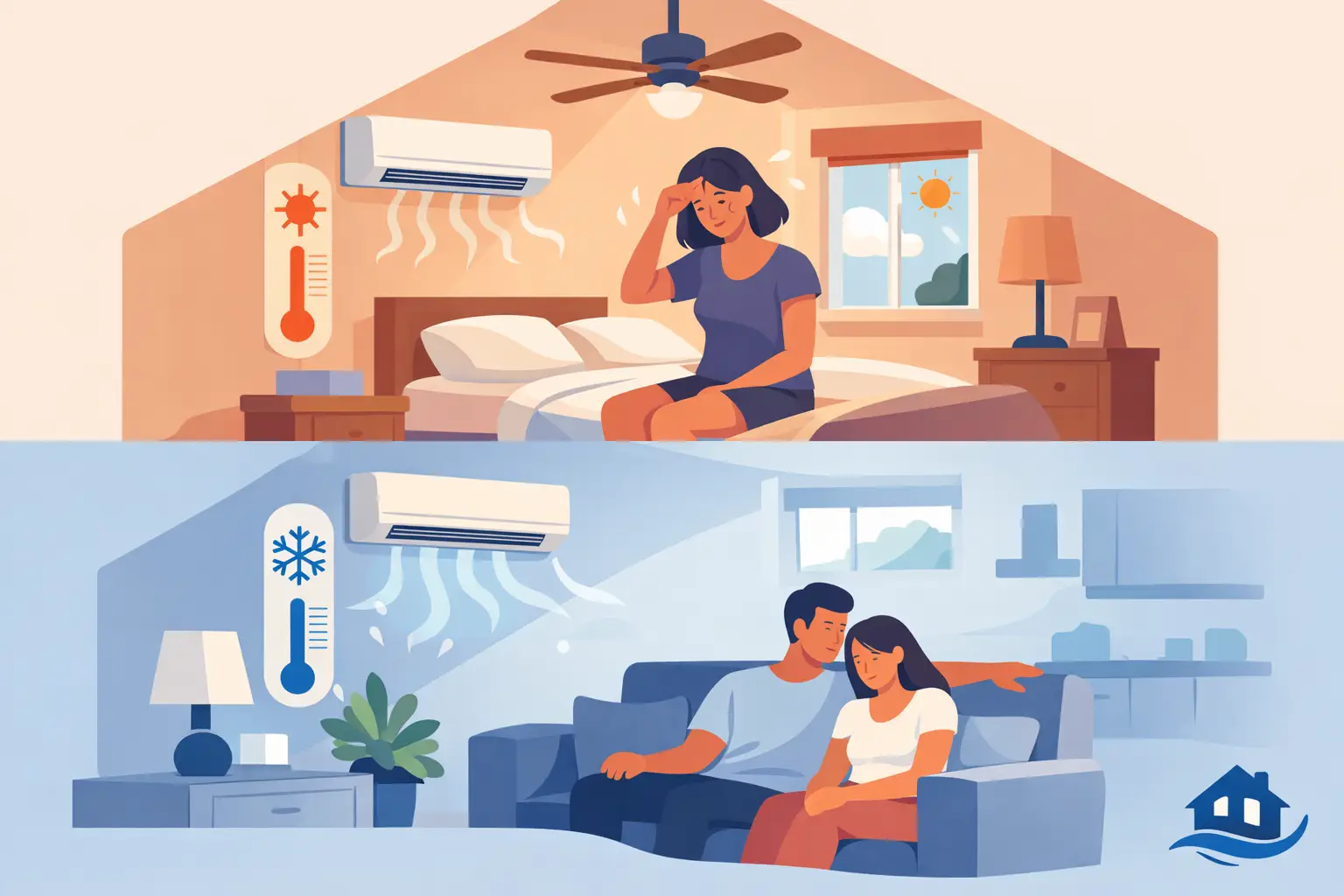
The downstairs thermostat is set to 72°F, but the bedrooms upstairs still feel warm, stuffy, and uncomfortable. If your AC is not cooling upstairs, the problem may be more than a particularly hot summer day. While upper floors naturally tend to be warmer because heat rises and roofs absorb solar heat, a properly maintained air conditioning system should still provide reasonably consistent comfort throughout the home.
Several factors can cause uneven cooling between floors. A dirty air filter, blocked return vent, thermostat location, restricted airflow, leaking ductwork, inadequate attic insulation, or an AC system with insufficient capacity can all contribute to a hot second floor.
Some problems are easy for homeowners to check, while others require professional HVAC diagnosis. Understanding where the problem occurs—one bedroom, several upstairs rooms, or the entire second floor—can help identify the most likely cause.
Why Is the Upstairs Hotter Than the Downstairs?
It is common for an upstairs floor to feel warmer than the first floor, especially during hot and humid weather. Heat naturally moves upward, while the roof and attic can transfer additional heat into the rooms below.
Homes with older insulation, inadequate air sealing, large windows, finished attic areas, or significant afternoon sun exposure may experience even greater heat buildup upstairs.
The distance between the HVAC equipment and the second floor can also affect comfort. Cool air has to travel through the duct system to reach upstairs rooms. If the ducts are undersized, leaking, poorly balanced, or restricted, less conditioned air may reach the upper level.
A small temperature difference between floors may be normal. However, if the upstairs consistently remains significantly warmer than the downstairs despite the AC running, it is worth investigating the cause.
Common Reasons Your AC Is Not Cooling Upstairs
1. A Dirty Air Filter Is Restricting Airflow
A dirty or clogged air filter can restrict the amount of air moving through your HVAC system. Your AC may continue running, but reduced airflow can make it harder for conditioned air to reach rooms that are farther away from the equipment.
Upstairs bedrooms may notice the problem first because they often depend on longer duct runs and may already have weaker airflow.
Check your filter regularly, particularly during periods of heavy AC use. Replace it according to the manufacturer’s recommendations. Homes with pets, construction dust, or other sources of airborne particles may require more frequent filter changes.
However, avoid installing a highly restrictive filter without confirming that your HVAC system is designed to handle it. Excessive airflow restriction can create additional performance problems.
2. Supply or Return Vents Are Blocked
Your HVAC system needs both supply and return airflow to operate properly.
Supply vents deliver conditioned air into the room, while return vents pull warm indoor air back toward the HVAC system. If either is blocked, air circulation can suffer.
Furniture, curtains, rugs, storage containers, and other household items can partially block vents. Closed bedroom doors can also affect airflow when there is no dedicated return vent inside the room.
Walk through the upstairs rooms and make sure supply registers are fully open and free from obstructions. Check return grilles as well and keep several inches of clearance around them whenever possible.
Avoid closing several downstairs vents in an attempt to force more cooling upstairs. This can increase duct pressure and may reduce overall system performance rather than solving the underlying problem AC Not Cooling Upstairs.
3. The Thermostat Is Located Downstairs
A single thermostat on the first floor may cause uneven temperatures in a multi-story home.
For example, if the downstairs reaches the thermostat’s 72°F setting, the AC may shut off even though the second floor is still several degrees warmer. This is especially likely when the thermostat is near a kitchen, sunny window, exterior door, or another location that does not represent the average temperature of the home.
First, confirm that the thermostat is set to Cool and that the fan is operating as intended. If the temperature difference between floors is consistent, an HVAC professional may recommend remote temperature sensors, a zoning system, improved thermostat placement, or another control strategy.
4. Ductwork Is Leaking or Poorly Balanced
Your AC can produce plenty of cool air without delivering it effectively to the upstairs rooms.
Leaking, disconnected, damaged, or undersized ductwork can allow conditioned air to escape before it reaches the second floor. These problems can be particularly important when ducts run through attics, crawlspaces, garages, or other unconditioned areas.
Air balancing can also affect upstairs comfort. HVAC systems use ductwork and dampers to distribute conditioned air throughout the home. If the system is not properly balanced, the first floor may receive more airflow while the upstairs receives less.
A qualified HVAC technician can measure airflow, inspect accessible ductwork, identify leaks or restrictions, and determine whether balancing or duct repairs are needed.
5. Your Attic Is Adding Excessive Heat
Sometimes the HVAC system is not the only reason an upstairs room feels hot.
An attic with inadequate insulation or poor air sealing can allow substantial heat to enter the upper floor. Gaps around attic access panels, recessed lights, duct penetrations, and other areas can also contribute to unwanted heat transfer.
Pay attention to how the upstairs feels during the day. If airflow from the vents feels strong but the rooms heat up again quickly, the home’s building envelope may be contributing significantly to the problem.
If airflow itself is weak, however, the HVAC system or ductwork may deserve closer attention.
In many homes, both issues can contribute to an uncomfortable second floor.
6. The Air Conditioner Has a Mechanical Problem
A mechanical problem can reduce the AC system’s overall cooling capacity, with upstairs rooms often revealing the issue first.
Potential causes can include a dirty evaporator coil, blower motor problem, capacitor failure, refrigerant-related issue, restricted airflow, or an outdoor unit that is not operating correctly.
If the AC is blowing warm air throughout the home, running almost continuously, freezing up, making unusual noises, or causing an unexpected increase in energy use, do not assume the problem is simply because the upstairs is hotter.
A professional HVAC inspection can determine whether the problem involves the equipment itself, airflow, ductwork, or another part of the cooling system.
Safe Checks You Can Make Before Calling an HVAC Professional
Before scheduling service, homeowners can perform a few basic checks without opening electrical panels or handling refrigerant components.
Start by confirming that the thermostat is set to Cool and the temperature is set below the current indoor temperature. Give the system enough time to operate and then compare airflow from the downstairs and upstairs supply vents.
You can also:
- Replace a visibly dirty air filter.
- Make sure upstairs supply vents are open.
- Clear furniture and other objects away from vents.
- Check that return grilles are not blocked.
- Keep the area around the outdoor AC unit clear.
- Look for obvious water around the indoor equipment.
- Listen for unusual sounds while the system operates.
Do not attempt electrical repairs, refrigerant work, or complex mechanical repairs yourself.
If your system has accessible manual dampers, avoid making major adjustments unless you understand the duct layout and the intended settings. Randomly changing dampers can create airflow problems elsewhere in the home.
If bedrooms do not have dedicated return vents, temporarily keeping the doors open during a cooling cycle may improve air circulation. If closing the doors consistently causes the rooms to become warmer, the home may need a better return-air solution, such as a transfer grille, jump duct, or properly designed return path.
When Does Poor Upstairs Cooling Require Professional Service?
A professional HVAC inspection is recommended when basic checks do not resolve the problem or when you notice signs of a more serious issue AC Not Cooling Upstairs.
Contact an HVAC professional if:
- The AC runs for long periods but cannot reach the thermostat setting.
- Upstairs airflow is significantly weaker than downstairs airflow.
- Ice forms on refrigerant lines or indoor equipment.
- The system repeatedly freezes up.
- You hear grinding, buzzing, clicking, or other unusual noises.
- You notice a burning or electrical odor.
- Water is leaking around the indoor unit, ceiling, or attic equipment.
- Cooling performance suddenly becomes worse throughout the home.
These symptoms can indicate electrical, drainage, airflow, refrigerant, or mechanical problems that should not be handled as DIY repairs.
For landlords, property managers, and business owners, addressing uneven cooling early can also help reduce tenant complaints, equipment downtime, and unnecessary energy costs.
Long-Term Solutions for a Hot Upstairs
The best solution depends on why the second floor is not receiving or retaining enough cooling.
Improve ductwork and airflow
If the central AC has enough capacity but conditioned air is not reaching the upstairs effectively, duct sealing, repairs, or air balancing may improve performance.
Improve attic insulation and air sealing
If excessive heat is entering from the attic, improving insulation and sealing air leaks can reduce the cooling load on the upper floor.
Consider HVAC zoning
A zoning system can provide separate temperature control for different areas of a home. This can be useful when the first and second floors have significantly different cooling requirements.
However, zoning adds equipment and complexity, so the existing HVAC system and ductwork should be evaluated before installation.
Consider a ductless mini-split
A ductless mini-split can provide targeted cooling for spaces such as a finished attic, upstairs bedroom, home office, or addition that is difficult to cool through the existing central duct system.
This can be particularly useful when extending or modifying existing ductwork is impractical.
Evaluate the size and condition of the AC system
If the central AC is aging, frequently repaired, or unable to meet the home’s cooling demand, replacement may eventually be appropriate.
However, installing a larger unit is not automatically the answer. An oversized AC can cycle too frequently and may not remove humidity effectively.
Before replacing an AC system, a proper load calculation and evaluation of the home’s insulation, ductwork, airflow, and existing equipment can help determine the appropriate system capacity.
How Rite Temp HVAC Can Help With Upstairs Cooling Problems
Rite Temp HVAC LLC evaluates more than just the air conditioner itself when homeowners experience uneven temperatures between floors.
A complete evaluation may consider equipment performance, airflow, ductwork, thermostat operation, insulation concerns, and how the different areas of the home are being used.
This approach can help identify the actual source of the comfort problem rather than simply treating the symptoms.
Whether the solution involves improving airflow, repairing ductwork, addressing insulation concerns, adjusting controls, or evaluating the existing AC system, identifying the underlying cause is an important first step.
A hot second floor should not have to be the price of summer. Addressing persistent cooling problems early can help improve comfort, reduce unnecessary strain on the HVAC system, and keep your home more comfortable throughout the cooling season.
Frequently Asked Questions
1. Why is my AC not cooling upstairs but cooling downstairs?
The downstairs may reach the thermostat’s set temperature before the upstairs does. Other possible causes include weak airflow, blocked returns, leaking or poorly balanced ductwork, inadequate attic insulation, thermostat placement, or insufficient AC capacity.
2. Why is my upstairs bedroom hotter than the rest of my house?
Upstairs bedrooms can become hotter because they are closer to the roof and attic, where heat can accumulate during the day. Poor insulation, air leaks, weak airflow, blocked returns, and inadequate ductwork can make the temperature difference even more noticeable.
3. Should I close downstairs vents to make my upstairs cooler?
Closing multiple downstairs vents is generally not a good long-term solution. It can increase pressure in the duct system and may reduce overall HVAC efficiency. If airflow is uneven between floors, professional air balancing or zoning may be a more appropriate solution.
4. Can attic insulation help if my AC is not cooling upstairs?
Yes. If heat from the attic is contributing to the problem, improving insulation and air sealing can reduce heat transfer into upstairs rooms. However, if the upstairs has weak airflow, an HVAC professional should also evaluate the ductwork and cooling system.
5. Do I need a new AC if the upstairs is always hot?
Not necessarily. A hot upstairs does not automatically mean the AC needs replacement. The problem could be caused by airflow restrictions, duct leaks, thermostat location, insulation, return-air problems, or system balancing. A professional evaluation can determine whether repair, improvement, zoning, or replacement is appropriate.
